Gawain and Bertilak: Challenge and Reconciliation
Sir Gawain and the Green KnightSir Gawain and Bertilak: Challenge and Reconciliation binds a courtly adventure to a private moral test. Sir Gawain first faces Bertilak as the Green Knight, an apparently otherworldly challenger whose surviving, watchful head makes the encounter seem beyond ordinary human terms. Only later does Bertilak identify himself and disclose that he arranged the test with Lady Bertilak. Their relation turns on that reversal: the figure who appears to be an alien threat is also the host who knows Sir Gawain’s conduct intimately, and who judges him with both knowledge of his fault and striking generosity.
A Courtly Adventure and Its Challenge
The poem frames its adventure through Arthur’s court and the appetite for marvels. Its narrator presents the story as an extraordinary adventure from Britain’s past, recalling Arthur as the most courteous of kings and describing the tale as a wonder and an outlandish adventure among his marvels. A further framing passage calls it one of Arthur’s early adventures, from the years when he was eager to hear boastful tales. That language makes the challenge more than a contest of strength: it enters a court already oriented toward daring stories, where a marvel can test the values that make such stories worth telling.
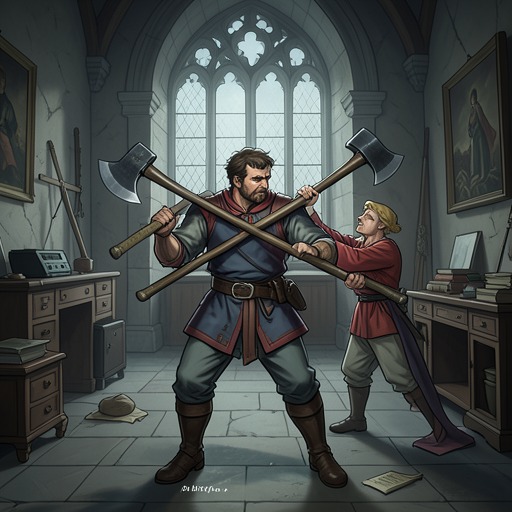
Sir Gawain’s relationship with the Green Knight begins in the presence of danger, but not in panic. When Sir Gawain comes forward carrying iron in his hand, he waits boldly rather than shrinking back. The Green Knight asks him to restate their terms before they go further. The request makes the encounter a matter of an acknowledged agreement, not simply an attack: the two men must face what has been promised between them. The challenge therefore establishes a bond even while it sets them in opposition.
From the Green Knight to the Host
The Green Knight’s first appearance unsettles the boundary between life and death. Holding his severed head upright, he turns its face toward the most honored person at the dais; the head opens its eyes and looks broadly across the hall. This gesture keeps the challenge present after the beheading: the severed head is not merely a trophy but an active witness, directing attention back toward the court and its obligations. For Sir Gawain, the challenge’s apparent impossibility gives his later meeting with the Green Knight the force of a reckoning already set in motion.
On the journey, the terms acquire a different atmosphere. After receiving directions toward a place of shelter, Sir Gawain rides on through deep forest, with high hills on either side. At the later meeting, his host laughs and tells him that he must stay longer, offering to guide him to his destination when the proper time comes and assuring him that the Green Chapel need no longer trouble him. The reassurance is double-edged: the destination is still in view, but the host speaks as if he knows more about Sir Gawain’s fear and purpose than an ordinary guide should. Hospitality becomes part of the suspense rather than a refuge from it.
The Test Disclosed
Bertilak’s final identification resolves the apparent separation between host and challenger. He names himself Bertilak de Hautdesert and says that Morgan le Fay, who lives in his house, enabled the transformation through her learned craft. The explanation places the marvel within a human arrangement: the Green Knight’s identity has been concealed, but the encounter has been prepared by people connected to the household where Sir Gawain was received.
Bertilak then connects the public challenge to the private test. The Green Girdle Sir Gawain wears is his own, he says, and Lady Bertilak wove it. He also says that he knows Sir Gawain’s kisses and conduct, and that Lady Bertilak’s wooing was his own work: he sent her to test Sir Gawain. The revelation changes the meaning of the hospitality and courtship. What seemed to be separate experiences—the host’s welcome, Lady Bertilak’s advances, and the encounter promised at the Green Chapel—are exposed as parts of one design. The girdle is concrete evidence linking those parts: it is at once a gift from the lady, an object made by Bertilak’s wife, and a sign that the test has reached beyond the public challenge.
Judgment and Reconciliation
Bertilak’s disclosure does not end in simple condemnation. He calls Sir Gawain the least faulty man ever to walk, comparing his worth to a pearl’s value against a white pea. The praise is significant precisely because Bertilak has just described the concealed test and identified the girdle Sir Gawain kept. He does not pretend that the test revealed nothing; instead, his judgment places the fault in proportion to the exceptional virtue that remains.
Reconciliation here takes the form of recognition: Bertilak tells Sir Gawain who he is, explains the forces and people behind the trial, and gives a measured judgment of the man who stood within it. Their relationship therefore moves from challenge, through concealed observation, to an encounter in which the terms of the past are finally made intelligible. The knight who once appeared as a supernatural adversary proves to be a host who has engineered the test, yet who can also acknowledge Sir Gawain’s worth. That doubleness makes their bond more than a contest with a victor: it is a confrontation that ends in disclosed identity and qualified esteem.